



For decades, the corporate playbook for reputation management has operated under a fundamental flaw: it treats media reports, press clips, and social media mentions as the source of reputation itself.
When a reputation crisis strikes, organizations rush to deploy public relations campaigns, launch press releases, or attempt to shape perception online. But measuring sentiment analysis, press coverage, or social media noise is akin to staring at a thermometer: it tells you the temperature of the room, but it doesn’t control the climate.
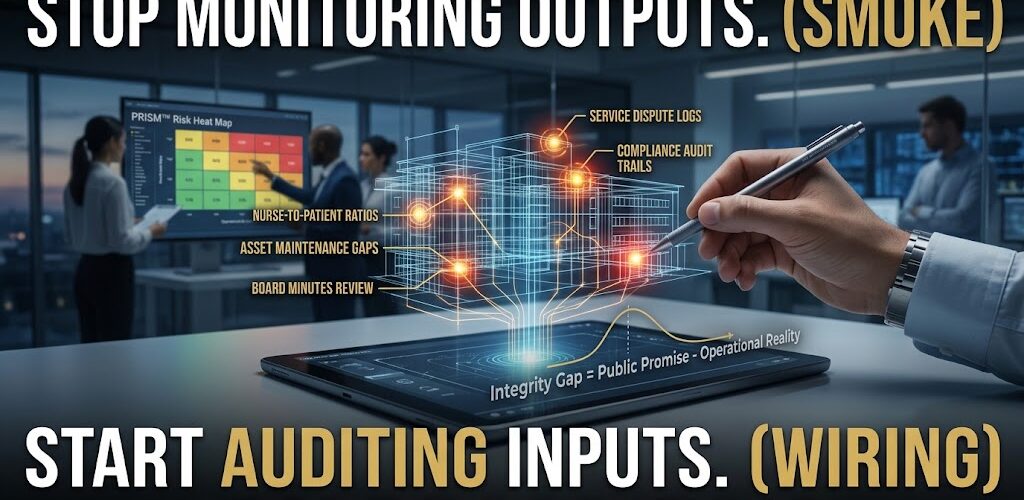
Media reports and social media trends are merely outputs and reflection signals (the “smoke”). They reflect what stakeholders observe, but they do not constitute the root cause of reputation itself.
If leadership teams want to move beyond reactive firefighting and build enduring institutional resilience, they must look beyond measuring outputs and start auditing operational inputs.
The Reality: Reputation is an Operational Byproduct
Reputation is not an abstract PR aesthetic or a clever narrative created in a creative strategy session. Reputation is the direct mathematical byproduct of how well an organization’s actual operational performance matches its public declarations.
This relationship is governed by the Integrity Gap:
Integrity Gap = The Promise – The Reality
- The Promise: What your organization declares through marketing, corporate governance policies, and brand commitments.
- The Reality: The daily, lived experience of your customers, employees, regulators, and host communities.
When an organization’s internal actions (“The Reality”) fall short of its brand claims (“The Promise”), an Integrity Gap opens. A single service breakdown, unaddressed compliance failure, or unresolved internal culture issue erases institutional trust, regardless of how polished the PR campaign might be.
Stop Measuring the Smoke: Shift from Output Scanning to Input Diagnosis
Traditional reputation management relies on output scanning – monitoring social media sentiment, tracking media impressions, or conducting post-crisis opinion polls. While these metrics provide visibility into public outrage, they suffer from a critical limitation: by the time an operational breakdown reaches the headlines, the damage has already occurred.
Output scanning doesn’t prevent reputational damage; it simply measures how quickly trust is eroding.
To achieve true reputation protection, executive leadership and boards must shift upstream to input diagnosis:
How to Audit Operational Inputs for Reputational Health
To move beyond superficial media monitoring, organizations should evaluate their risk profile against core operational indicators in areas such as:
- Service Delivery & Touchpoints
- Governance & Compliance Integrity
- Internal Culture & Human Capital
The Bottom Line
Media coverage doesn’t create reputation: it merely broadcasts the outcome of operational behaviors. Organizations that rely solely on media monitoring to safeguard their brand are paying to watch the smoke rather than checking the internal wiring.
By auditing upstream operational inputs and systematically closing the Integrity Gap, leadership teams can transform reputation management from a soft PR function into an auditable, board-ready metric of institutional strength.
Actions create reputation; the media simply reports the score